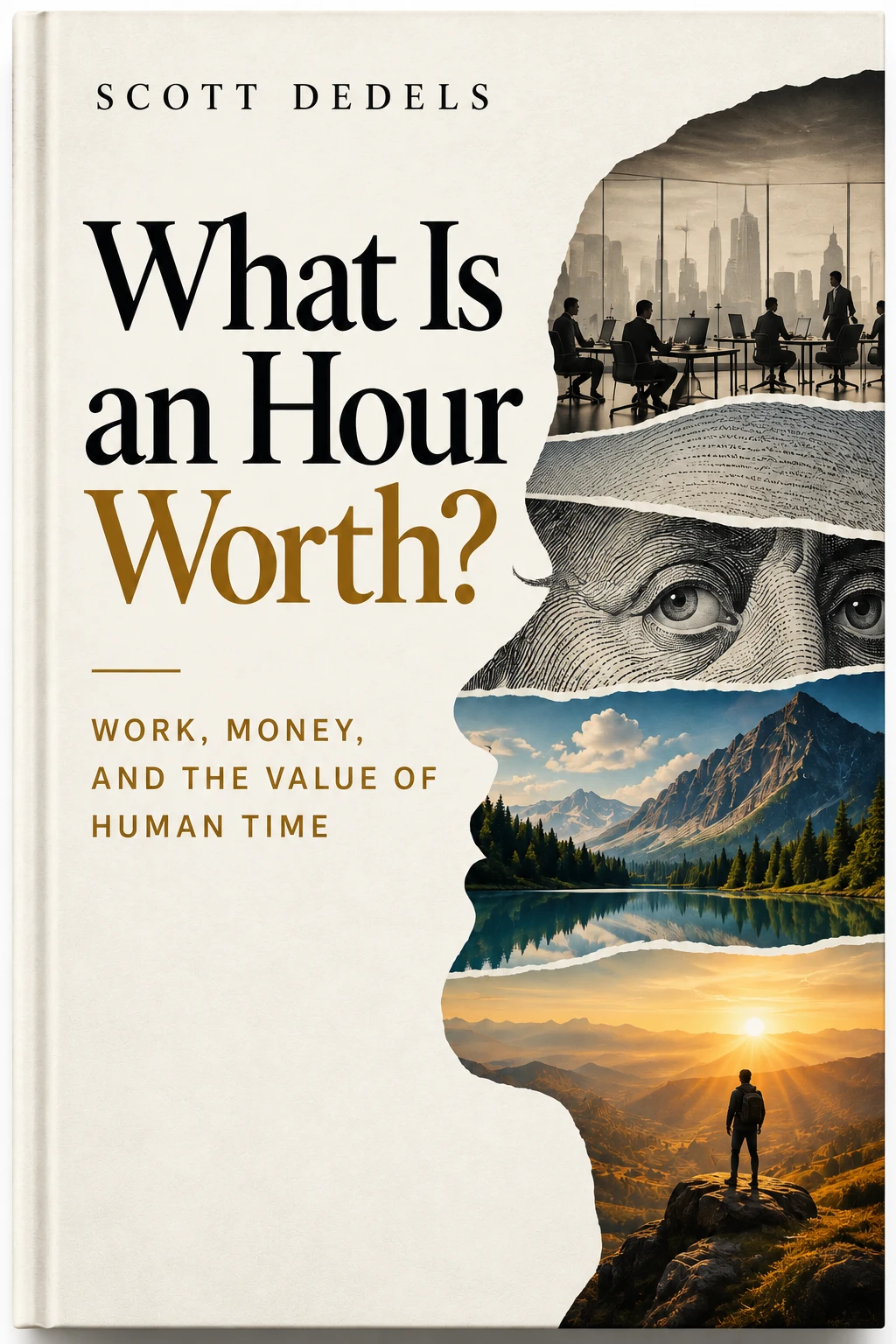
What Is an Hour Worth?
Work, Money, and the Value of Human Time
Every paycheque converts hours of a life into money. The compensation profession has become very good at measuring that money on the day it is paid. It has almost no way of asking what it is worth on the day it is finally needed.
This book asks that question, and follows it wherever it goes: through the history of wages, the disappearance of the pension, the unexamined job every household now performs alone, the money that compensation is paid in, and what an employer could build tomorrow with the payroll systems and laws it already has.
Two questions the pay stub cannot answer
Of the value an employer delivered, what actually arrived at the life it was meant to fund? And when should the answer be measured?
For most of the last century nobody needed to ask. Prices were stable, careers stayed with one employer, and a pension did the carrying. All three conditions have weakened. The habit of judging pay at the moment of delivery has not. The book calls that habit the Delivery Assumption, and spends its first half showing what it hides.
The spine of the book. Hour, wage, claim, carrier, seam, arrival, life. Employment is episodic. The liability it is meant to fund is continuous. By the final chapter, the unit of analysis is no longer the pay period. It is the life.
Who it is for
- HR and total rewards leaders who design pay and benefits and suspect the scorecard stops too early.
- CFOs and executives who already think about time rigorously for the top of the organization and would like a method for everyone else.
- Benefits and pension advisors working in the space the defined benefit plan left behind.
- Anyone who has ever wondered why a raise felt smaller than the number on the letter.
How it is built
The parts stand on their own and can be tested separately. The Prologue through Chapter 11 make the measurement argument and never mention Bitcoin. Chapters 12 through 16 are a labelled laboratory on money as a design variable, written under a disclosed commercial conflict, in which the author's preferred instrument fails several of the book's own tests. Chapters 17 and 18 describe what can be built with current payroll systems and current law, and depend on no conclusion from the laboratory. A reader who skips the monetary chapters loses two ideas and keeps the rest.
Twenty chapters, a prologue and an epilogue
- The measurement argument
- Prologue Fairly Measured When?
- 1 What Is an Hour Worth?
- 2 When Time Became Wages
- 3 The Temporal Contract
- 4 $10,000 Is Not $10,000
- 5 The Executive Exception
- 6 The Fourth Job
- 7 Whose Time?
- 8 The Second Job
- 9 Money Is Not Capital
- 10 The Retirement Machine
- 11 The Architecture of Arrival
- The monetary laboratory
- 12 The Ruler
- 13 The 21 Million Experiment
- 14 The Hearing
- 15 The Deflationary Wage
- 16 What Remains of Retirement
- What can be built now
- 17 The Temporal Paycheque
- 18 The Temporal Balance Sheet
- The life
- 19 The Last Scarce Worker
- 20 The Purpose of Compensation
- Epilogue What Arrived
Fairly Measured When?
Consider two women starting the same job, forty years apart. Neither is a real person, but everything about their circumstances is.
In 1984, a woman we will call Margaret takes a job in the finance department of a mid-sized manufacturer. She is twenty-six. Her offer letter runs to two pages and describes a salary, health coverage, and a pension. The salary she negotiates, mildly. The health coverage she checks for her doctor. The pension she doesn't read at all. There is a booklet, and the booklet goes in a drawer. Nothing about the pension requires anything from her. That is the point.
In 2024, her granddaughter takes a job at a firm of the same size. She is twenty-six. By almost every modern measure of compensation, her offer looks better: stronger real cash pay, broader benefits, a wellness allowance, a stock purchase plan, an employer match her grandmother never had, a larger stated annual rewards value. The offer letter is longer than Margaret's and handsomer, and everything in it is true.
On her first afternoon, between orientation sessions, a screen will ask her a series of questions her grandmother was never asked. […] Fifteen minutes, four decisions, forty years of consequences, and then the tour of the building.
Three papers, one talk, one book
The book is the long form of an argument first worked out in three research papers and compressed into five minutes for a DisruptHR talk. The papers carry the formal apparatus. The book carries the people: Margaret and her granddaughter, a passbook, a commuted pension, and the question the author has not stopped asking since.
If you want the vocabulary before you start, the glossary defines every term the book coins. If you want to test the thinking in smaller pieces first, start with the essays.
Publication details to follow. Join the launch list and you will hear once, when it is available, with no other mail.
Tell me when it launches