What is an hour of your life worth?
Not what your employer pays you for an hour. What the hour itself is worth, by the time you finally get to spend it. Those turn out to be very different questions, and the compensation profession only has a rigorous answer to the first one.
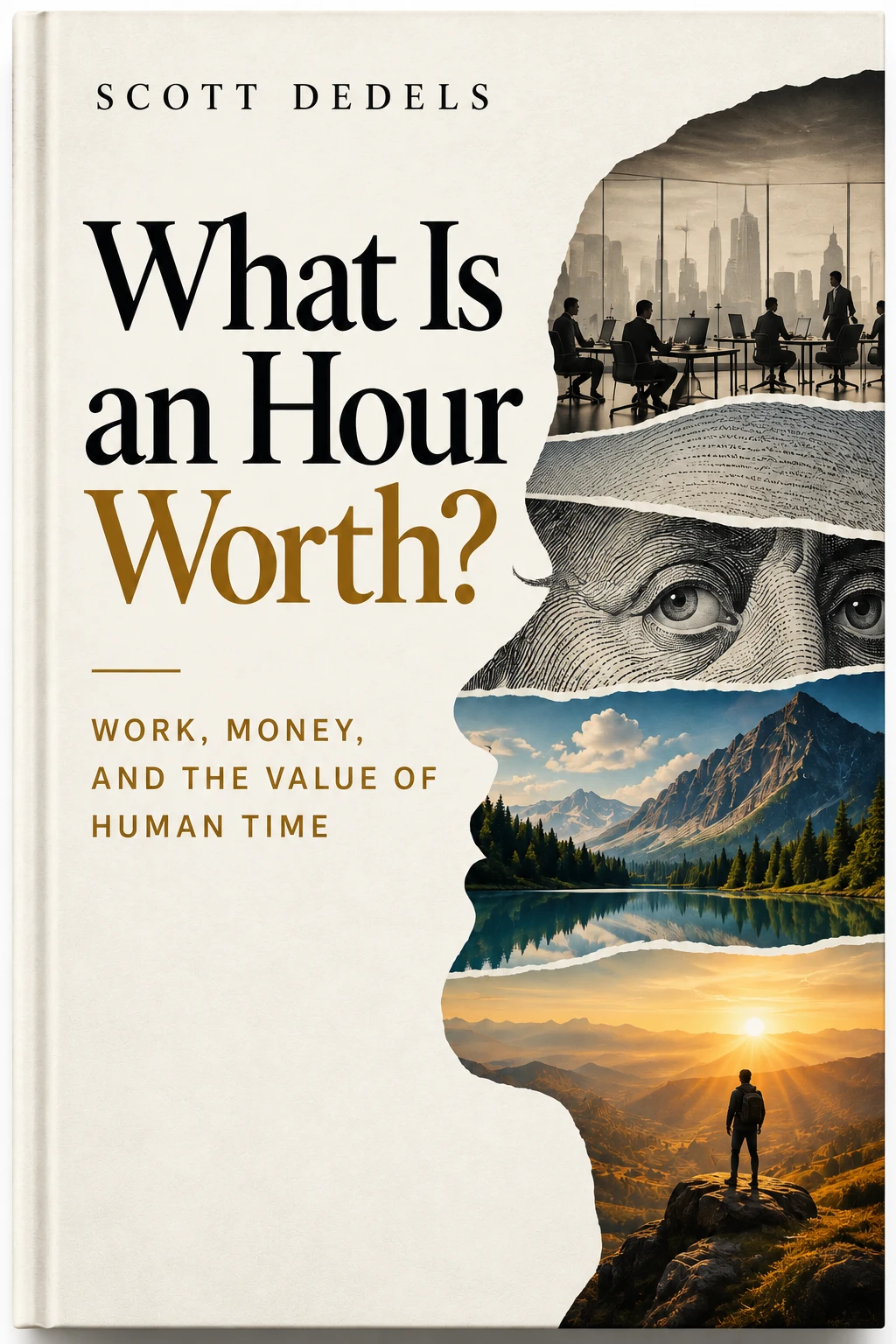
The book · Forthcoming
What Is an Hour Worth?
Work, Money, and the Value of Human Time
The long form of everything on this site. Twenty chapters that follow one question from the invention of the wage to the life it is meant to fund: of the value an employer delivered, what actually arrived?
The argument
Every employment relationship begins with an exchange we rarely describe honestly. An employee gives an employer something they can never get back, which is their time. In return, they are given money.
An entire profession exists to make that exchange work. We benchmark. We design salary structures, bonus plans, equity grants, pensions, benefits. Over about a century we have become genuinely sophisticated at answering one question: how much should we pay this person?
We have been much less curious about a second one. When is that compensation supposed to create value?
Think about your own pay. Some of it buys dinner tonight. Some becomes a down payment in five years. Some pays for a child's education in fifteen. And some of it supports a version of you who will not exist for another forty. These are all dollars. They are not doing the same job.
Temporal Compensation Theory is an attempt to take that second question seriously. It begins from a single restatement: compensation is the transfer of purchasing power through time, rather than the delivery of pay. Sit with that sentence and a set of questions becomes unavoidable, none of which the field has a standard method for. What happens to the value of an employee's work after the money lands? What carries it? Who is accountable for the design of the thing that carries it? And what should be required of the money that finite human time gets converted into?
The Delivery Assumption. The inherited belief that compensation's obligations end at payroll: that what is delivered is what is received, and that everything after delivery belongs to some other discipline. It lives in instruments and institutions rather than in anybody's intentions, which is exactly why it survived the conditions that once made it reasonable.
Those conditions were real. Stable prices, employees who stayed for a career, and a pension that did the carrying. All three are largely gone. The assumption stayed.
What follows on this site is the work of taking that seriously: three research papers, a working vocabulary of about twenty-five terms, the book, and shorter essays as the thinking develops.
The research
Three papers, one argument
Each paper takes up the question the one before it creates. None of them names an asset until the third, and the third declines to recommend one.
Paper I
Temporal Compensation
Establishes the definition, names the Delivery Assumption and the Executive Exception, moves the unit of analysis from the compensation event to the compensation journey, and identifies Preservation as the fourth job of a paycheque.
Paper II
Preservation Architecture
Asks what an architecture must actually do to carry deferred value across decades. Defines the preservation target as the worker's future liability, develops a ten-layer stack, and ends with six tests any architecture can be held to.
Paper III
The Monetary Denominator
Treats money as a design variable rather than a neutral measuring stick. The ruler is also the payment, and the ruler moves. Derives six desiderata before any candidate is named, then tests one.
The talk
The Missing Dimension of Total Rewards
Five minutes, twenty slides, fifteen seconds each. The DisruptHR format gives you no room to hedge, which makes it a good test of whether an idea holds up when every qualifying clause has been stripped out of it.
Watch and read the transcript